BackgroundIncludes press-layer reports
- Event date (reported)
- Published
- Last updated
Background This event is more than 90 days older than this page. It is kept here as dated context, not as current news.
What changed
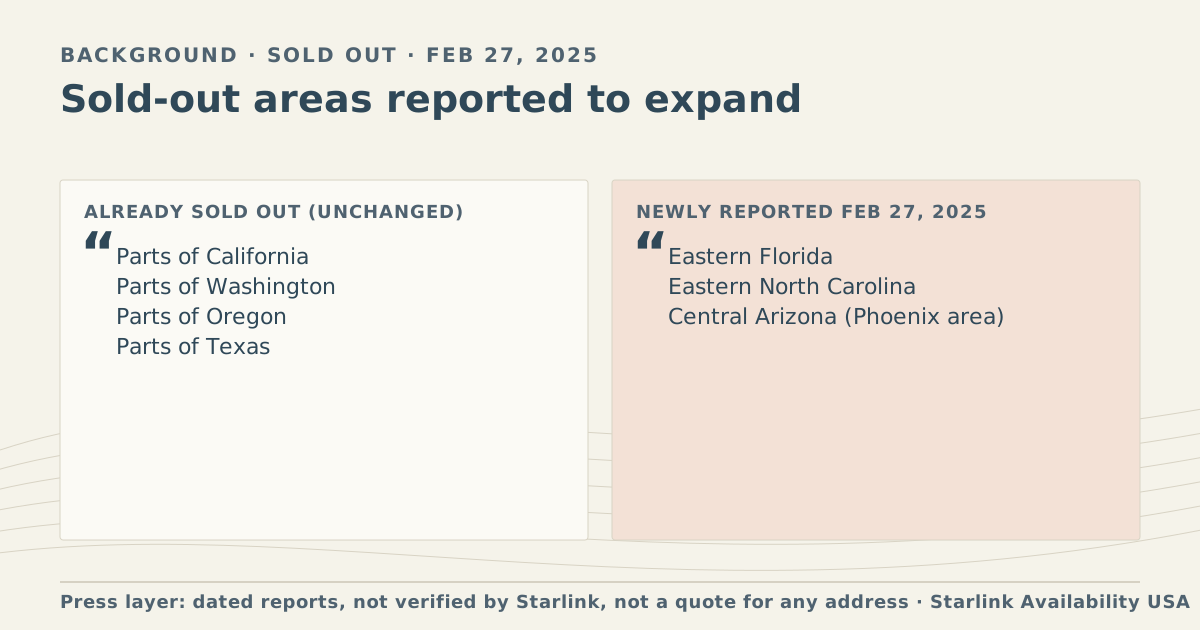
On February 27, 2025, SatelliteInternet.com reported that Starlink’s availability map showed new sold-out areas in eastern Florida, eastern North Carolina and central Arizona around Phoenix. The report said areas that were already waitlisted in California, Washington, Oregon and Texas had not changed, and that it had seen no reports of customers being moved off those lists.
The article explained the limit in one line: each satellite “can only communicate with a limited number of dishes at once without sacrificing performance.”
What it means for you
This was the second wave of sold-out areas after the November 2024 return of the waitlist (see our earlier item). It moved the problem from mainly West Coast and Texas metros to the Southeast and the Southwest.
If you were in one of these areas in early 2025 and saw “sold out”, that was the network’s local capacity, not a problem with your order. Buying a kit somewhere else did not change it: activation still depended on capacity at your service address (our page on whether retail avoids it explains why).
Who was affected
- New Residential buyers in the named regions.
- The report described regions, not counties or ZIP codes.
- Existing customers were not reported as losing service.
What you can check now
- Your address’s current status shows on Starlink’s own map and at checkout. Starlink’s help text says sold-out areas use a deposit queue and that it gives no timelines.
- If Residential is not available at your address, our page on what “not available” means lists the usual reasons and options.
- Dated entries like this one are collected in the sold-out log.
What stays the same
Starlink’s description of sold-out status (Residential at capacity, deposit to be notified, no timeline) is the same in its current help article as it was described in 2025.
How this fits the record
Some of the same places show up again in later surcharge reports. Phoenix was named in April 2025 reports of a $250 charge, and Asheville in western North Carolina was named at $500 in June 2025. That fits a pattern seen elsewhere: areas that run out of capacity tend to stay on the list of high-demand addresses even after they stop being sold out. We note the overlap; the reports themselves do not draw that link.
What we don’t know yet
- The exact boundaries of “eastern” Florida and North Carolina in this report.
- How long these areas stayed sold out. A January 2026 report said North Carolina had moved to surcharges instead of a sold-out status; we have no matching report for Florida or Arizona.
- Whether these areas later carried demand surcharges at the same amounts.
Our data
None for this period. This is a press-layer entry.
Source
Report on Starlink sold-out areas expanding (February 2025)
Retrieved Oct 6, 2026
Correction log
No corrections since publication.
Found an error? See corrections or contact. Fixes are made in place, dated and listed here.