BackgroundIncludes press-layer reports
- Event date (announced)
- Published
- Last updated
Background This event is more than 90 days older than this page. It is kept here as dated context, not as current news.
What changed
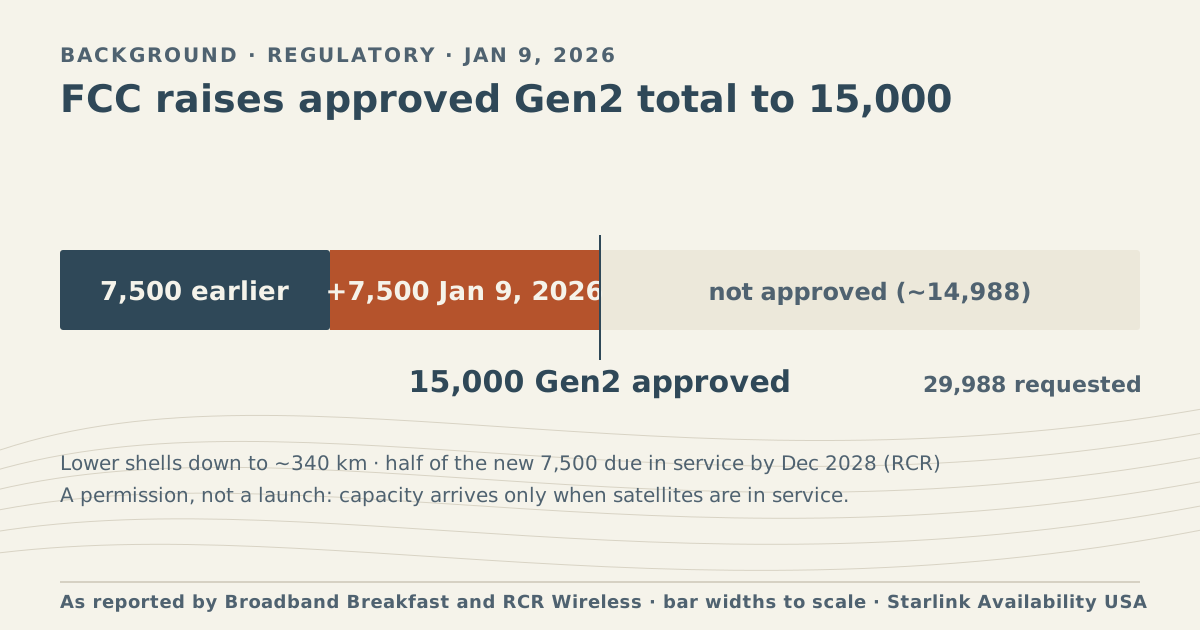
On Friday, January 9, 2026, the Federal Communications Commission approved SpaceX’s request to build and operate 7,500 more Gen2 Starlink satellites, bringing the total approved Gen2 constellation to 15,000, according to Broadband Breakfast and RCR Wireless.
The reports describe these details:
- SpaceX had asked for 29,988 Gen2 satellites. Roughly half remain unapproved.
- Satellites may use lower orbital shells, down to about 340 km (RCR gives a range of 340 to 485 km).
- Operation across Ku-, Ka-, V-, E- and W-band frequencies.
- A deadline for half of the newly approved satellites to be operating by December 2028 (RCR).
- Conditions to protect geostationary satellite operators from interference, and a time-limited waiver for higher-power operation (RCR).
Broadband Breakfast quoted SpaceX’s filing on the aim: “symmetrical download and upload speeds, thus enabling fiber-like service for American consumers”.
What it means for you
This is a permission, not a launch. It sets the upper limit on how many satellites SpaceX may fly in this generation. Capacity only arrives when satellites are built, launched and in service.
For readers in sold-out or high-surcharge areas, the decision is one of the steps that could, over years, add capacity where it is short. RCR quoted an analyst view that the approval could let the network grow its capacity several times over, but that is a projection, not a schedule for any area.
Who this covers
- SpaceX’s Gen2 system as a whole. The decision is not specific to any state or county.
What you can check now
- Nothing changes at your checkout because of this decision. Your address’s availability and any surcharge still show at checkout.
- Follow dated changes to sold-out areas on our sold-out log and surcharge changes on the timeline.
What stays the same
Availability is still decided by capacity at your service address. The surcharge rules in Starlink’s help text are unchanged by this decision.
How this fits the record
Capacity limits are behind every sold-out map and every demand surcharge we track. An analyst quoted by RCR noted that SpaceX was close to using up its earlier approval of 7,500 Gen2 satellites, so this decision lets launches continue. The other half of the capacity story is satellite size: SpaceX’s next-generation V3 satellites, which first flew on a test flight in July 2026 (our item).
What we don’t know yet
- How many of the newly approved satellites will be launched in 2026.
- When, or whether, extra capacity will reach specific US areas that are congested today.
- We could not open the FCC’s own document from our location, so the details above come from the two press reports.
Our data
None.
Source
FCC Approves 7,500 More Starlink Gen2 Satellites
Retrieved Oct 6, 2026
RCR Wireless report on the FCC approval of 7,500 additional Starlink satellites
Retrieved Oct 6, 2026
Correction log
No corrections since publication.
Found an error? See corrections or contact. Fixes are made in place, dated and listed here.