NewsIncludes press-layer reports
- Event date (reported)
- Published
- Last updated
What changed
SpaceX’s Starship Flight 13, launched from Starbase, Texas, deployed 20 Starlink V3 satellites, the first V3 satellites to fly. Earlier Starship flights had carried mass simulators instead.
The satellites were not placed into operational orbit. Interesting Engineering reported that they “briefly established contact with the existing Starlink network before re-entering Earth’s atmosphere and burning up as planned.” Drive Tesla Canada said they burned up about 20 minutes after deployment because Starship had not reached orbital velocity.
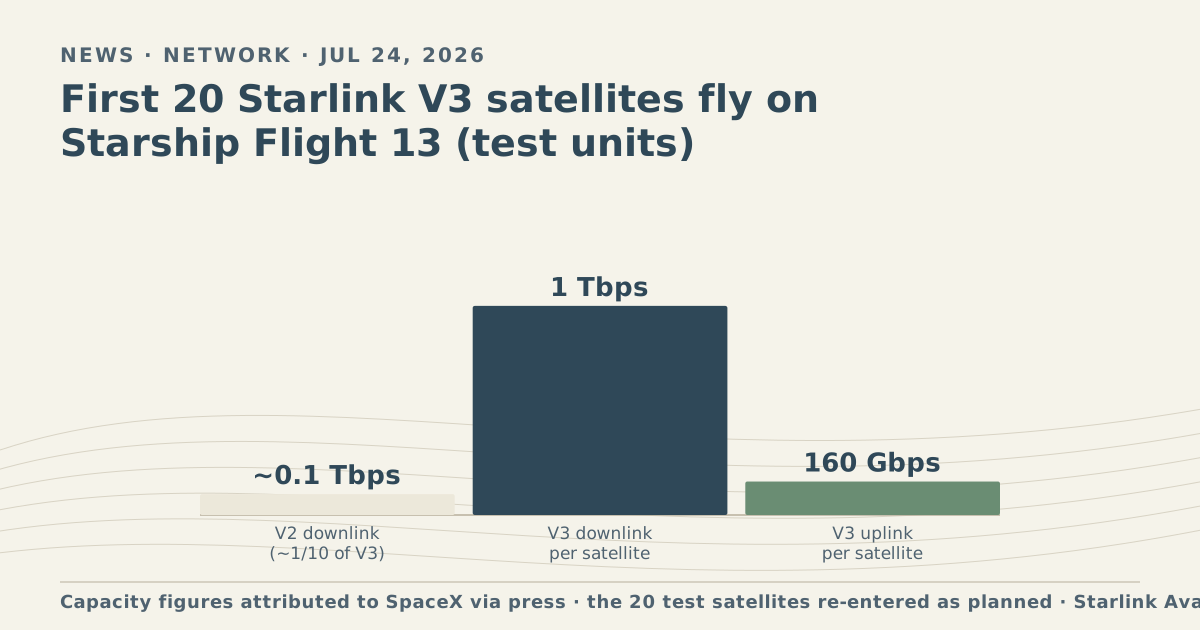
According to SpaceX, as reported by Drive Tesla Canada, “each V3 satellite is capable of delivering up to 1 Tbps of downlink capacity”, about 10 times a V2 satellite, plus 160 Gbps of uplink.
A note on the date
Press accounts we read put liftoff on a Friday evening at 5:51 p.m. Central, which is July 24, 2026. One outlet’s account implies July 23. We use July 24 and will correct it if a primary source says otherwise.
What it means for you
Nothing changes for any customer yet. These satellites were test units and are gone.
The flight matters because V3 is the hardware Starlink has pointed to for a large jump in capacity. In July 2025 SpaceX said it was targeting the first half of 2026 to begin launching V3 satellites (our item). This test came just after that window. Capacity is what drives sold-out areas and demand surcharges, so operational V3 launches are the development most likely to affect them over time. When, and where, is not known.
Who this covers
- No customers directly. It is a test of the launch vehicle and the satellite design.
What you can check now
- Nothing at checkout changes because of this flight. Your address’s availability and any surcharge still show there.
- We log dated capacity changes on the sold-out log and surcharge changes on the surcharge timeline.
What stays the same
The network serving customers today is made up of earlier-generation satellites. Starlink’s plan speed ranges and surcharge rules are unchanged by this flight.
Why the capacity figure matters
A single V3 satellite at the stated 1 Tbps would carry about ten times the downlink of a V2 satellite, by SpaceX’s own comparison. How much of that reaches any one area depends on how many V3 satellites are launched into service and where demand is highest, which SpaceX has not set out for US regions. Sold-out maps and demand surcharges both come from local capacity running short, so this is the change to watch.
What we don’t know yet
- When the first V3 satellites will be launched into operational orbit.
- How quickly V3 capacity could reach congested US areas.
- The V3 capacity figures come from SpaceX via press; they have not been independently measured.
Our data
None.
Source
SpaceX Deploys First V3 Starlink Satellites as Starship Completes Most Successful Test Flight Yet
Retrieved Oct 6, 2026
Interesting Engineering report on Starship Flight 13
Retrieved Oct 6, 2026
Correction log
No corrections since publication.
Found an error? See corrections or contact. Fixes are made in place, dated and listed here.