BackgroundIncludes press-layer reports
- Event date (announced)
- Published
- Last updated
Background This event is more than 90 days older than this page. It is kept here as dated context, not as current news.
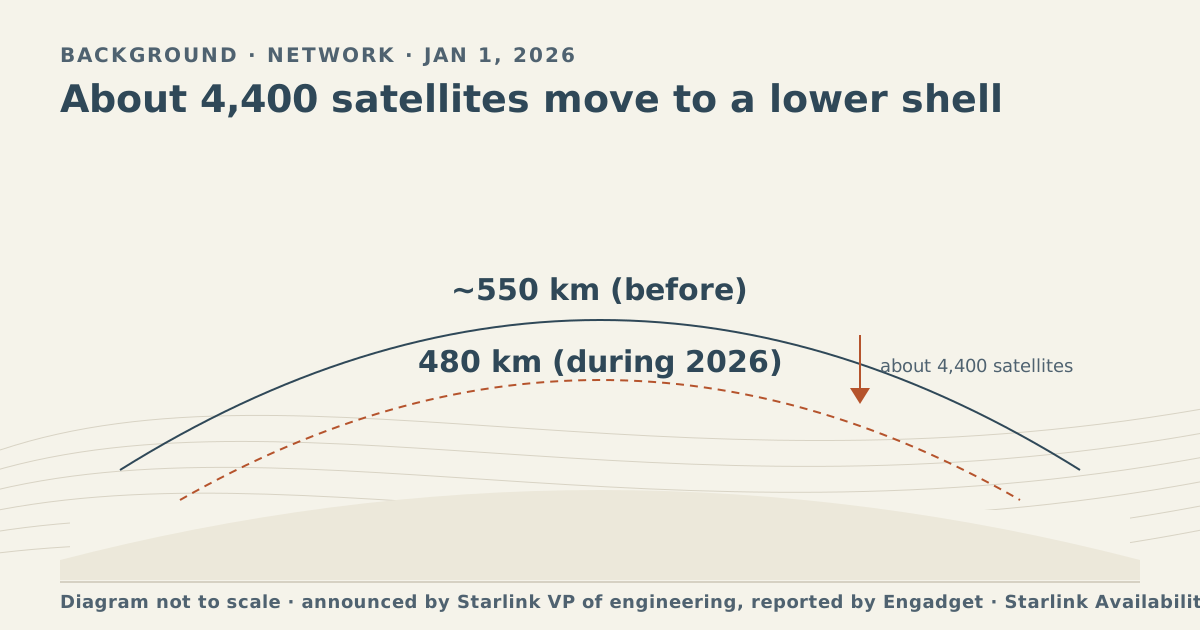
What changed
On January 1, 2026, Engadget reported that Michael Nicolls, Starlink’s vice president of engineering, had announced on X that about 4,400 Starlink satellites would be lowered from about 550 km to 480 km over the course of 2026.
The stated reasons were about space safety: less debris and traffic below 500 km, faster natural decay of any satellite that fails, and preparation for the coming solar minimum, when thinner air will slow that decay. Engadget quoted the post: “Lowering the satellites results in condensing Starlink orbits, and will increase space safety in several ways.”
What it means for you
The announcement did not mention any change to service, prices, availability or surcharges, and Engadget’s report did not describe service impact. We are not aware of a Starlink statement linking the move to customer speeds or capacity, so we do not draw that link here.
What it does tell readers is that the constellation is being actively reshaped in 2026. That is useful context when you see speed or availability change in your area: Starlink’s network is not static, and local capacity can shift for reasons that are not announced per area.
Who this covers
- About 4,400 satellites in the roughly 550 km shell. The report did not say what share of the whole constellation that is.
- No customer action was described.
What you can check now
- If your speeds change, compare tests at the same time of day over several days before drawing conclusions (see evening speeds).
- Our coverage guide explains what Starlink’s own map shows and leaves out.
What stays the same
The service you order, the way availability is decided by your address, and the surcharge rules in Starlink’s help text are not affected by this announcement as reported.
Why it came up now
Starlink’s stated reasons were general: less debris below 500 km, faster decay of failed satellites, and the solar minimum expected in the early 2030s, which will make the upper atmosphere thinner and slow natural decay. The post also cited the risk from launches and maneuvers by other operators that are not coordinated with Starlink. None of the reasons given relate to customer demand, prices or availability, so we do not treat this as a capacity change.
What we don’t know yet
- Whether the move has any measurable effect on latency or speed for US users. A lower orbit is shorter to reach, but no figure was given.
- How far the move had progressed by the time of writing. We saw later press reports of progress but could not retrieve them, so we do not cite numbers.
Our data
None.
Source
Starlink is lowering thousands of satellites' orbits to reduce risk of collisions
Retrieved Oct 6, 2026
Correction log
No corrections since publication.
Found an error? See corrections or contact. Fixes are made in place, dated and listed here.