Key takeaways
- The demand surcharge is a one-time charge, not a monthly fee. Starlink's article says it may apply “when purchasing or activating Starlink service.”
- It is one-time per triggering event and per service line. A second kit on its own line, a move into a high-demand area, or a later plan switch can each bring a new one.
- Moving between two high-demand areas is prorated: what that line already paid is credited, so you may pay only the difference.
- Resuming from Standby at the same address doesn't charge again if you already paid there. Starlink's Standby page still says no surcharge applies at all; the two pages disagree.
- A retail kit bought as a replacement creates a new service line and can trigger it. Starlink says to contact Support first.
On this page
The Starlink demand surcharge is a one-time charge, not a monthly fee. Starlink’s help article says “a one-time demand surcharge may apply when purchasing or activating Starlink service” in high-demand locations, and it never appears as a recurring line on your bill.
But “one-time” means one time per triggering event, per service line. The same article lists events that can bring a new surcharge later: moving into a high-demand area, switching plans, buying a retail kit instead of a Support replacement, or moving back to an old address. Other events are protected. This guide sorts every situation Starlink describes into “once” and “can come back”, with a worked example.
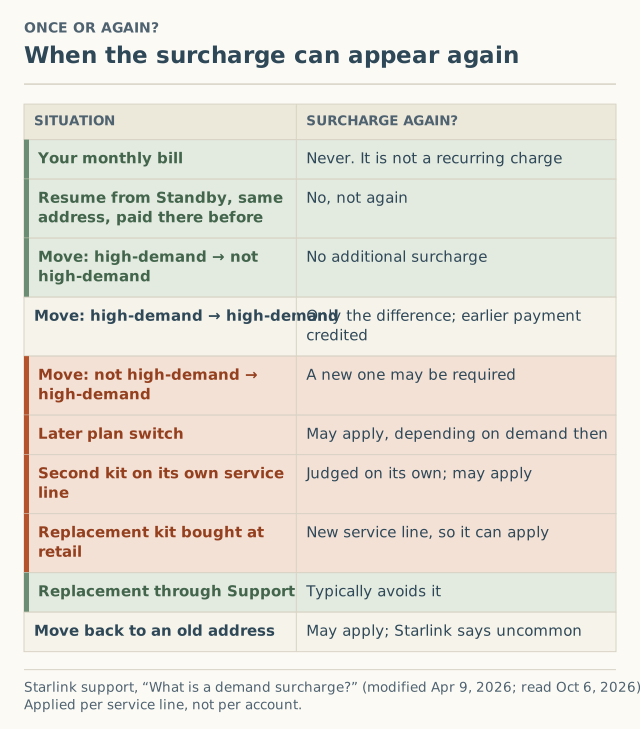
The short answer, situation by situation
| Situation | Can a surcharge apply again? |
|---|---|
| Your monthly bill | No. It’s not a recurring charge |
| Resume from Standby, same address, already paid there | No: “without paying the surcharge again” |
| Resume from Standby, never paid for that location | May apply, depending on location and plans at the time |
| Move: high-demand → not high-demand | “No additional surcharge will apply at the time of the move” |
| Move: high-demand → high-demand | Prorated: earlier payment on that line is credited; you “may only pay the difference” |
| Move: not high-demand → high-demand | “A new demand surcharge may be required” |
| Later plan switch | May apply, “depending on availability and demand in your area at the time of the change” |
| A second kit on its own service line | Yes, possibly: each line is evaluated independently |
| Replacement kit bought at retail | Can apply: it “creates a new service line” |
| Replacement through Support | “Typically avoids triggering a demand surcharge” |
| Move back to a previous address | May apply; Starlink calls this “uncommon” |
Why it’s “per service line”, and why that matters
Starlink’s article says: “Demand surcharges are applied per service line, not per account. Each active service line is evaluated independently based on its registered service address and plan.”
A service line is one subscription tied to one kit (or group of kits) and one service address. Three things follow:
- A second dish is a second line. If you add a kit for a barn or a second building on a new subscription, that line is quoted on its own, even at a high-demand address where your first line already paid.
- What you paid stays with that line. The proration credit on a move is “any previously paid surcharge for that specific service line.” It doesn’t transfer to another line on your account.
- Moving one line doesn’t touch the others. “If you have multiple service lines on one account, moving one line does not affect surcharges tied to other service lines.”
The events that can bring it back
Moves
Moves are the most common way the fee returns. Starlink’s three cases:
- High-demand to high-demand: prorated. Your line’s earlier payment counts toward the new location’s surcharge, and you may pay only the difference, if any.
- High-demand to not high-demand: nothing more at the move.
- Not high-demand to high-demand: a new surcharge may be required “based on current network capacity.”
Note the asymmetry. The credit only helps when both ends are high-demand. If you moved away to a quiet area and later move into a busy one, you can face a fresh charge. Moving back to a previous address is also listed: a surcharge “may apply depending on network demand at that time. This is uncommon but may occur if availability has changed.”
Step-by-step moving guidance is in how to change your service address. Don’t list an address other than where the dish will be used to avoid a fee; here is why that backfires.
Plan switches
“If you switch service plans later, a demand surcharge may be applied depending on availability and demand in your area at the time of the change.” Starlink’s plan-change article says Residential plans can be changed “at any time, subject to availability in your area.” Before you confirm a switch, read the screen for a surcharge line. Plans and pricing are outside what this site covers.
Replacement hardware
This is the costly one people don’t see coming. Starlink:
“If you purchase a new kit via retail instead of going through Support, this creates a new service line. As a result, you will be subject to the demand surcharge if your service address is in a high-demand area at the time of activation.”
A Support replacement “does not create a new service line and typically avoids triggering a demand surcharge.” Starlink’s own advice: “We strongly recommend reaching out to Support first for any replacement needs.”
Resuming from Standby
Here Starlink’s pages disagree. The demand surcharge article says Standby “does not remove or waive demand surcharges. It only preserves your previous eligibility for your service address.” Already paid there: resume without paying again. Never paid there: one may apply. The Standby article’s FAQ, modified the same day, still says: “No, you will not have to pay a demand surcharge if you pause your service with Standby Mode and then resume later.” We cover the conflict in our news item. Whether to pause at all is a decision outside this site; we only report the surcharge side.
How the rules changed
The “one-time” idea has held since the start, but the list of events that trigger it has grown.
- September 2024. Starlink’s support wording, as quoted in a press summary: “This fee will only apply if you are purchasing or activating a new service plan.” It added: “Our intention is to no longer charge this fee to new customers as soon as network capacity improves.”
- April 9, 2026. The current article adds address changes, moves, later plan switches, retail replacements and moving back, plus the Standby rule. RV Mobile Internet reported the change the same day: “Standby Mode no longer waives a demand surcharge - instead, it only preserves prior eligibility.”
The dated record is on our surcharge history page.
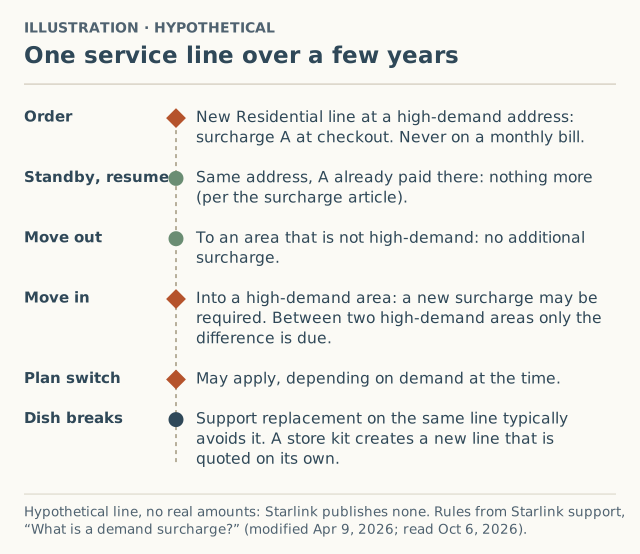
Worked example: a household over three years
A hypothetical household, with letters instead of amounts because Starlink publishes none:
- Year 1. They order Residential at a high-demand address and pay surcharge A at checkout. Their monthly bill never shows it again.
- Year 1, winter. They pause with Standby and resume in spring at the same address. Per the demand surcharge article: no new charge, because they paid A there.
- Year 2. They move to another high-demand county. Checkout for the move shows surcharge B. Their line’s earlier payment of A counts toward it, so they may pay only B minus A, if B is larger.
- Year 2, later. The dish is damaged. They contact Support, get a replacement on the same line, and typically avoid a new surcharge. Had they bought a store kit and activated it as new, the new line would have been quoted on its own.
- Year 3. They add a second kit for a workshop on its own subscription. That new line is evaluated independently and may carry its own surcharge.
Total: one fee for the original order, a possible difference on the move, and a possible separate fee for the second line. Never a monthly charge.
Edge cases
- A charge after a support session. A July 2, 2026 MobileSyrup report described a customer billed $1,500 after a small coordinate change in their address record, later refunded. That’s one report (press layer), possibly not in the US; see our item. Check your bill after any address edit.
- You think a repeat charge is wrong. Starlink: “If you believe you were incorrectly charged the demand surcharge, please create a ticket for further review.” A calm checklist is in reactivation quote higher than expected.
- You change your mind after ordering. Return within the 30-day window and “any eligible demand surcharge will be refunded.”
What we don’t know
- Whether the amount on a move uses today’s figure or the original one. Starlink says the new location’s surcharge is “based on current network capacity”; it doesn’t say how the difference is calculated beyond the credit.
- How often moves back actually trigger it. Starlink calls it uncommon. We have no crowd counts yet.
- Which Standby page billing follows. Reader reports of resumes will help. Crowd reports in our record for this event so far: not enough reports yet.
Common mistakes
- Expecting the fee on every bill. It’s one-time; a recurring line is something else (Standby fee, plan price).
- Buying a store kit to replace a broken dish. It creates a new line. Contact Support first.
- Assuming one payment covers every line. Each service line stands alone.
- Assuming the credit always applies on a move. Only between two high-demand areas.
What to do next
- Before any move, plan switch or new kit, stop at the confirmation screen and read it for a surcharge line.
- See the full trigger list: what triggers a demand surcharge.
- Check what readers report near you on the surcharge explorer (cells publish at n ≥ 5).
- If a repeat surcharge appeared, report it with the event, month, plan and county. Never your address.
Questions people ask
Is the Starlink congestion charge monthly?
Can I be charged the Starlink demand surcharge twice?
Do I pay the surcharge again if I move?
Will I pay the surcharge again after Standby?
Does a second Starlink kit at the same address pay its own surcharge?
Is the surcharge refunded if I return the kit?
Sources
- Starlink support: What is a demand surcharge? (modified Apr 9, 2026) (retrieved Oct 6, 2026)
- Starlink support: How does pausing service work? (modified Apr 9, 2026) (retrieved Oct 6, 2026)
- Starlink support: How do I change my service address? (modified Apr 9, 2026) (retrieved Oct 6, 2026)
- Starlink support: Service Plan Changes (modified Jul 10, 2026) (retrieved Oct 6, 2026)
- Blandin on Broadband (summarizing PCMag): Starlink charges $100 congestion charge, Sep 20, 2024 (retrieved Oct 6, 2026)
- RV Mobile Internet: Starlink changes demand surcharge policy for Standby Mode and service address moves, Apr 9, 2026 (retrieved Oct 5, 2026)
- MobileSyrup: $1,500 Starlink surcharge after address verification, Jul 2, 2026 (retrieved Oct 6, 2026)
Related guides
Surcharges
What triggers a Starlink demand surcharge? One flowchart
The four events that trigger a Starlink demand surcharge, the one condition behind all of them, and the edge cases: moves, Standby, plan switches.
Owners
How to change your Starlink service address after a move
Step-by-step: change your Starlink service address on desktop or in the app, what to check first, why it can fail, and when a move brings a demand surcharge.
Owners
Starlink reactivation quote higher than expected: a calm checklist
Resuming Starlink and the quote shows a demand surcharge? Six checks before you confirm, the two Starlink help pages that disagree, and when to open a ticket.