BackgroundIncludes press-layer reports
- Event date (reported)
- Published
- Last updated
Background This event is more than 90 days older than this page. It is kept here as dated context, not as current news.
What changed
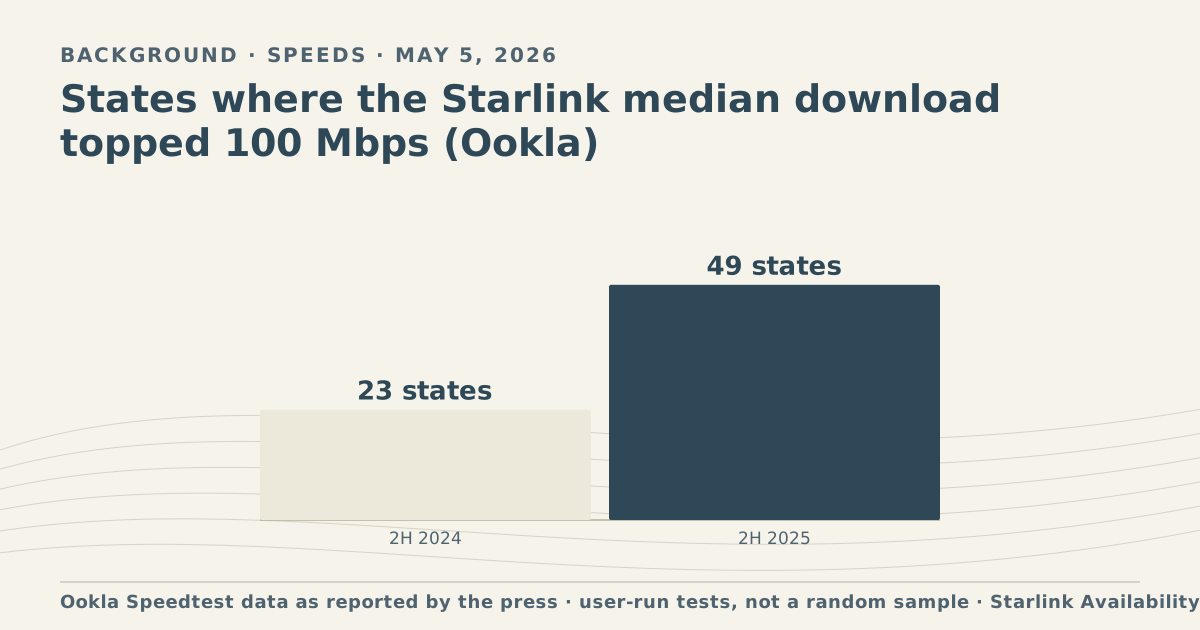
An Ookla analysis by Sue Marek, summarized by the Benton Institute on May 5, 2026, said Speedtest users on Starlink saw median download speeds above 100 Mbps in every state except Alaska in the second half of 2025. That compares with 23 states in the second half of 2024.
The same analysis reported progress on latency: the number of states with a Starlink median latency under 40 ms grew from 1 to 10 between 2H 2024 and 1H 2025, and the lowest medians were 37 ms in New Jersey, Colorado, Arizona and Washington, D.C. It noted: “Starlink has said that its goal is to deliver satellite service with just 20 milliseconds (ms) median latency”.
Techlicious, the same day, reported that 44.7% of US Starlink users met the FCC’s 100/20 Mbps benchmark by Q4 2025.
What it means for you
A year earlier, a 100 Mbps median was the national average at best (our Q1 2025 item). By late 2025 it was the floor in 49 states. If your own tests sit well below 100 Mbps at most times of day, you are now further from typical than you would have been in 2024, and it may be worth checking for obstructions or testing at different hours.
The figures also show that upload remains the gap: fewer than half of users met the FCC’s 20 Mbps upload line in Q4 2025, according to Techlicious.
Who this covers
- Speedtest users on Starlink in the US. It is not a random sample, and it mixes plans.
- State medians, not county medians. Speeds can vary a lot within a state.
What you can check now
- Compare your tests with your plan’s stated range on our upload and download page.
- See why evenings are slower before reading too much into a single test.
- Our speed explorer publishes a county median only with 20 or more reader tests.
What stays the same
Starlink’s support pages still give plan speeds as typical ranges, and peak hours (6 pm to 11 pm local) are still when speeds are most likely to drop.
What we don’t know yet
- Alaska’s exact 2H 2025 median from this summary. The summary says only that Alaska was the one state below 100 Mbps.
- How much of the improvement holds at peak hours specifically.
Our data
None yet for speeds. Press and company figures are never merged with our crowd medians.
Source
Starlink Hits New Highs in the U.S.
Retrieved Oct 6, 2026
Techlicious report on Ookla Starlink data and FCC broadband speeds
Retrieved Oct 6, 2026
Correction log
No corrections since publication.
Found an error? See corrections or contact. Fixes are made in place, dated and listed here.