Key takeaways
- The form asks for state and county (required) and the first 3 ZIP digits (optional). Never a street address, GPS location or full ZIP.
- County is the smallest area we publish. Smaller areas could point to a household.
- There's no free-text box and no screenshot upload, because checkout screenshots usually show the address.
- No IP address, cookies or login are stored with a report. A salted daily hash for rate limiting is deleted after 24 hours.
- Nothing is sent to SpaceX or Starlink. For an address-level answer, your own checkout is the only source.
On this page
- How precise each level is
- What we never collect
- Why not collect addresses and protect them?
- The trade-offs we accept
- Worked example: what one report looks like
- If you need an address-level answer
- What county-level data can and can’t answer
- Sharing your quote elsewhere, safely
- Why Starlink needs your address and we don’t
- Why county, not city or town
- What we don’t know
- Common misunderstandings
- What to do next
- Questions people ask
- Sources
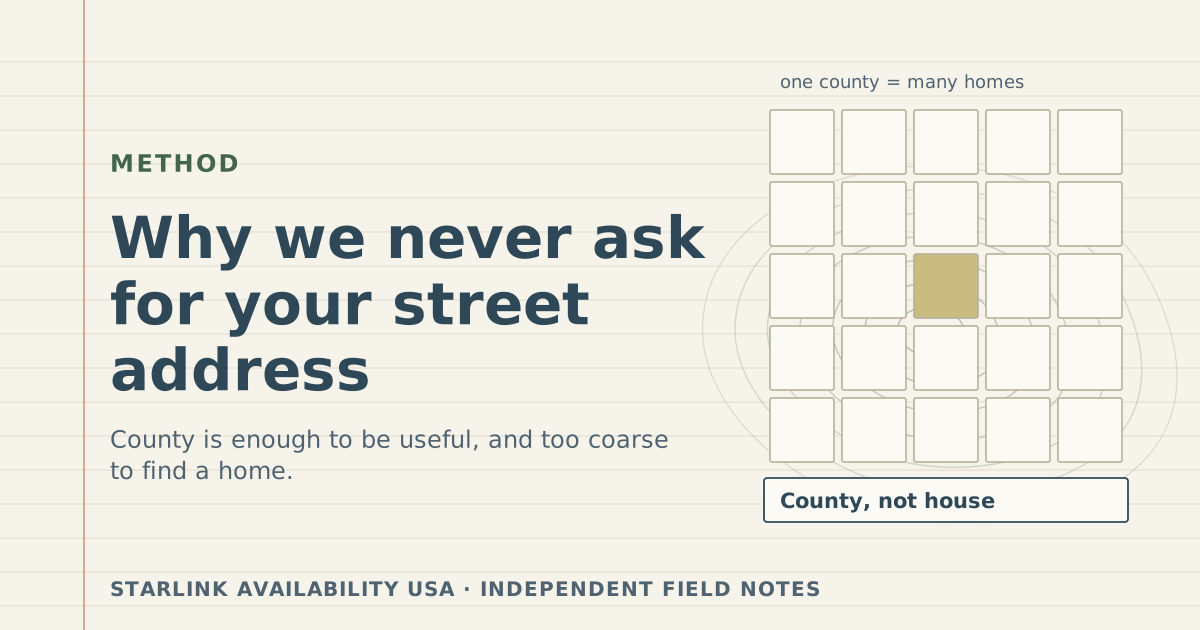
Our report form never asks for your street address because we don’t need it and holding it would put you at risk. Starlink sets the surcharge by service address and plan, and only Starlink’s checkout can quote your address. What this site answers is a different question, what’s typical in your county, and a county is precise enough to answer it while being far too large to point to anyone’s home. So the form takes your state and county, and optionally the first three digits of your ZIP code, and nothing more precise.
The same reasoning rules out screenshots, free text, logins and stored IP addresses. This page explains each choice and the trade-offs we accepted by making it.
How precise each level is
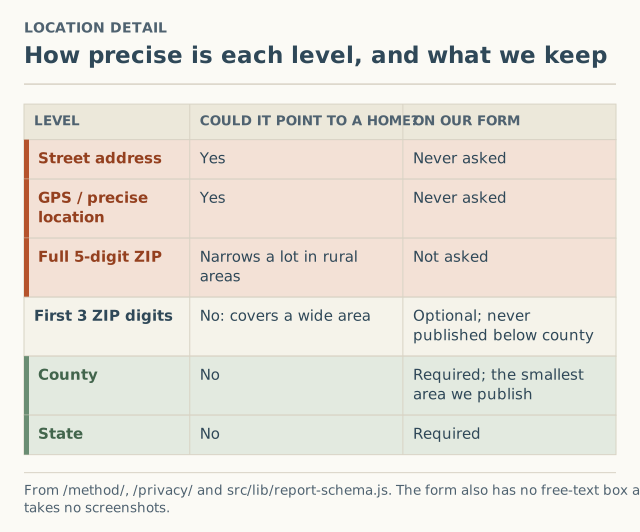
| Level | Could it point to a home? | On our form |
|---|---|---|
| Street address | Yes | Never asked |
| GPS / precise location | Yes | Never asked |
| Full 5-digit ZIP | Narrows a lot in rural areas | Not asked |
| First 3 ZIP digits | No: covers a wide area | Optional; never published below county |
| County | No | Required; the smallest area we publish |
| State | No | Required |
Why county
Counties are the smallest area we publish. They’re large enough that a county-level summary doesn’t point to a household, and they’re standard: the Census Bureau treats counties and their equivalents (parishes in Louisiana, boroughs and census areas in Alaska) as the primary divisions of each state, with fixed codes, so data from different sources lines up. They also match how people already talk about local conditions (“what are people in my county seeing?”).
Why only three ZIP digits
Some counties are huge. A ZIP prefix helps spot differences inside them without getting personal. The form refuses anything but exactly three digits (“Use only the first 3 digits of your ZIP code, or leave it blank”), so a full ZIP can’t slip in. ZIP3 stays in the raw data and is never published below county level.
What we never collect
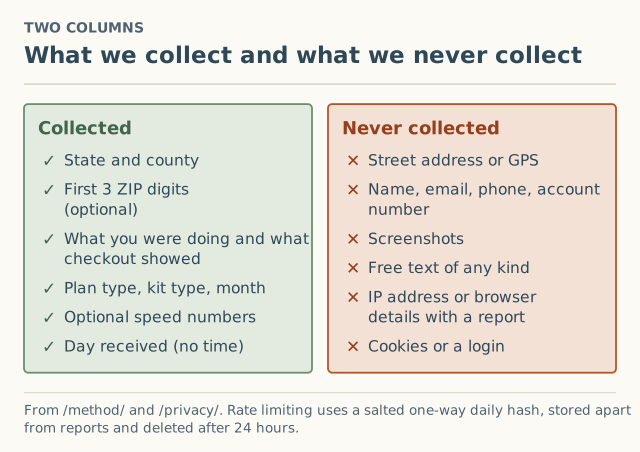
- No street address, GPS or precise location. See above.
- No name, email, phone or Starlink account number. We don’t need to contact you, so we don’t ask.
- No screenshots. A checkout screenshot is the most natural evidence of a surcharge, and it usually shows the service address. The form accepts no files.
- No free text. A comment box is where people paste addresses, account numbers and names. There isn’t one.
- No IP address or browser details with a report, no cookies, no login. To stop one person flooding a county, the server makes a one-way hash of a secret salt, the date and your IP, and counts reports against it for 24 hours. The hash is stored apart from reports, deleted automatically, and can’t be turned back into an IP or linked to what you reported.
- Nothing to SpaceX. Reports are used only for published county totals and the open dataset. We don’t sell or share raw reports.
The form also refuses unknown fields: the server accepts only the listed fields and rejects anything else.
Why not collect addresses and protect them?
Because the safest data is data you never hold. Three reasons it wouldn’t help anyway:
- We couldn’t give you a better answer. Starlink’s surcharge article says the fee “is determined by: your service address; the service plan selected.” The only system that can turn your address into a quote is Starlink’s checkout. An address in our database would give us nothing to tell you that your own checkout doesn’t.
- Publishing would still be at county level. Anything finer could point to a household, so an address would be collected only to be thrown away.
- Breaches and requests. Data that isn’t stored can’t leak, be subpoenaed or be misused.
The trade-offs we accept
| What we give up | What it means for the data |
|---|---|
| Address-level detail | Two homes in one county can see different results; a county median is a guide, not your quote |
| Verification against a checkout | We can’t confirm a report is real; we rely on checks, outlier holds and review |
| Follow-up questions | We can’t ask a reporter to clarify; unclear reports are rejected |
| Finding “your” report | We usually can’t locate one person’s report to delete or correct it |
Starlink also says service “is only guaranteed at the service address listed on your account,” and that’s another reason the address belongs between you and Starlink, not with us.
Worked example: what one report looks like
A hypothetical reader in a large western county reactivates a dish and sees a surcharge. Their report, exactly as stored:
| Field | Value |
|---|---|
| State | WA |
| County | (5-digit county code) |
| ZIP3 | 993 |
| Event | Reactivating a dish |
| Result | A surcharge, with an amount |
| Amount | (whole dollars) |
| Plan | Residential |
| Kit | Kit I bought |
| Month | 2026-09 |
| Day received | Set by us, for duplicate checks |
That’s the whole record. Nothing in it identifies the reader, and nothing is lost for the purpose of a county median. How it moves from here to a published number is in how the dataset is built.
If you need an address-level answer
- Surcharge: start an order on starlink.com with your real address and plan, and stop at the summary (how).
- Availability: Starlink’s availability map (how to read it).
- Your account: Starlink support. Starlink’s surcharge article says that if you believe you were charged incorrectly, “please create a ticket for further review.”
What county-level data can and can’t answer
| Question | Can county data answer it? |
|---|---|
| Are surcharges common where I live? | Yes, once the county has 5 reports |
| What’s the typical amount near me, recently? | Yes: median and range, with dates |
| Which situations bring fees here (new orders, moves, reactivations)? | Yes: the most common trigger |
| Are evenings slower than mornings here? | Yes, once there are enough speed tests per band |
| What will I pay at my address? | No. Only Starlink’s checkout can say |
| Is my house obstructed? | No. Use the app’s obstruction check |
Sharing your quote elsewhere, safely
If you post about a surcharge in a forum or social group, the same logic protects you:
- Crop or retype instead of screenshotting. Checkout screens usually show the service address.
- Name the county, not the street. It’s enough for others to compare.
- Leave out account numbers and order IDs.
- Add the date and plan. Without them, a quote can’t be compared with anyone else’s.
Why Starlink needs your address and we don’t
Starlink and this site have opposite jobs, so they need opposite data.
| Starlink | This site | |
|---|---|---|
| Job | Provide service at one location | Describe what’s typical across many locations |
| Needs your address? | Yes: service “is only guaranteed at the service address listed on your account,” and the surcharge is “determined by” it | No: a county answers county questions |
| Can quote your surcharge? | Yes, at checkout | No |
| Holds your identity? | Yes, it’s your account | No: no name, email or account number |
Your address belongs in one place: your Starlink account. Everything we publish is built so that it never needs to be anywhere else.
Why county, not city or town
Cities might seem more natural, but they make poor reporting units for Starlink. Many of the households most interested in satellite internet live outside any city limits, in unincorporated areas that have no city to choose. City boundaries also change and overlap with ZIP codes in confusing ways. Every US address is in a county or county equivalent, the lists are fixed, and the Census Bureau’s county codes let our data line up with other public datasets. A county is also large enough that publishing its median doesn’t expose anyone.
What we don’t know
- Whether county is always coarse enough. In very small-population counties, even county-level data plus other details could narrow things. That’s one reason we publish only medians and ranges at n ≥ 5, never individual reports.
- How much accuracy we lose by not having addresses. We can’t measure it without the data we chose not to collect.
Common misunderstandings
- “A free site that doesn’t ask for my email must be selling something else.” We collect no identifiers to sell. How the site is funded is on how we make money.
- “No address means the data is useless.” It means the data answers county questions honestly. It was never meant to be your quote.
What to do next
- Read the full list on the method page and the privacy page.
- See how a county gets published.
- Add your report. It takes about two minutes.
Questions people ask
Why don't you ask for my address to give me an exact surcharge?
Is the first 3 digits of my ZIP code identifying?
Why can't I upload a screenshot of my checkout?
Do you store my IP address?
Do you share reports with Starlink or SpaceX?
Can I get my report deleted?
Sources
- Starlink support: What is a demand surcharge? (modified Apr 9, 2026) (retrieved Oct 6, 2026)
- Starlink support: How do I change my service address? (modified Apr 9, 2026) (retrieved Oct 6, 2026)
- US Census Bureau Geography Glossary: County or Statistically Equivalent Entity (retrieved Oct 6, 2026)
Related guides
Method
How the Starlink Availability USA dataset is built, start to finish
Every step from an anonymous Starlink surcharge or speed report to a published county number: form checks, outlier holds, human review, thresholds and the CSV.
Method
How a county gets published: the n ≥ 5 and n ≥ 20 rules
When a county gets Starlink surcharge or speed numbers on this site: 5 reports or 20 tests in a rolling 6-month window, what a published cell shows, and why.
Speeds
How to run a Starlink speed test that counts
Run a Starlink speed test you can compare: what to pause, which test to use, why three runs, which time band, the obstruction check, and what to record.