Key takeaways
- They are the same fee: a one-time charge Starlink may add at checkout when the service address is in a high-demand area. Starlink's help article calls it a “demand surcharge”.
- “Congestion charge” comes from Starlink's own 2024 wording: “In areas with network congestion, there is an additional one-time charge”. Press reports kept the name.
- Starlink still uses “congestion charge” in one help article (Regional Savings, modified Apr 9, 2026), so both names are Starlink's.
- Don't confuse it with slower speeds during network congestion, the Standby monthly fee, a waitlist deposit, or the separate one-time “Activation Charge” article.
- Search both names when you look up history. Our crowd and press records file them as one fee.
On this page
Yes, the Starlink congestion charge and the demand surcharge are the same fee. Both names describe a one-time charge that Starlink may add at checkout when the service address is in a high-demand area. Starlink’s help center calls it a “demand surcharge” today. “Congestion charge” comes from Starlink’s own wording in 2024, and most news coverage kept that name.
What causes real confusion is a set of other charges and effects that sound similar: slower speeds during network congestion, the Standby monthly fee, a waitlist deposit, and a separate one-time “Activation Charge” article. This guide shows where each name comes from, how to tell the fee apart from its look-alikes, and what to search for.
Where each name comes from
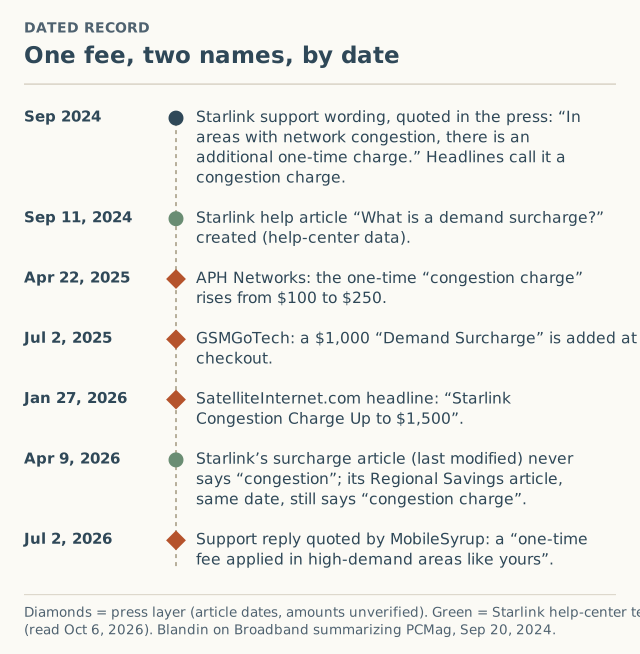
“Congestion charge” came first. In September 2024, press reports described a new $100 one-time charge on some Residential orders. Blandin on Broadband, summarizing PCMag on September 20, 2024, quoted Starlink’s support wording:
“In areas with network congestion, there is an additional one-time charge to purchase Starlink Residential services.”
The same summary quoted two more lines: “This fee will only apply if you are purchasing or activating a new service plan,” and “Our intention is to no longer charge this fee to new customers as soon as network capacity improves.” A fee for areas with network congestion became the “congestion charge” in headlines.
“Demand surcharge” is the help-center name. Starlink’s help article titled “What is a demand surcharge?” carries a creation date of September 11, 2024 in the help center’s data and was last modified April 9, 2026. It opens: “In certain locations where network demand is high, a one-time demand surcharge may apply when purchasing or activating Starlink service.” The article never uses the word “congestion”.
Starlink still uses both. Starlink’s Regional Savings article (modified April 9, 2026) says customers who change address or plan “will be billed the amount of the regional savings and any congestion charge in the country.” So you’ll find the older name on starlink.com too.
The press uses both, often in one article. APH Networks wrote in April 2025 that SpaceX was raising “the one-time ‘congestion charge’” from $100 to $250. GSMGoTech wrote in July 2025 that “a glaring $1,000 ‘Demand Surcharge’ is added.” SatelliteInternet.com’s January 2026 headline reads “Starlink Congestion Charge Up to $1,500”, and its text calls it a surcharge. Those amounts belong to our press layer: one place, one date, unverified.
What support called it in 2026. In a July 2, 2026 MobileSyrup report, Starlink support described the charge as a “one-time fee applied in high-demand areas like yours to manage network capacity.” Neither name, same fee.
Why the name doesn’t change anything
Whatever the line says, the rules are the ones in Starlink’s demand surcharge article:
- It’s set by your service address and the plan you select.
- It applies when you buy new service, activate a new plan in a high-demand area, change your service address to a high-demand area, or move between addresses.
- It’s applied per service line, not per account.
- If you return the hardware within the 30-day return window, “any eligible demand surcharge will be refunded.”
- Starlink publishes no amounts and no map. You see the figure only at checkout.
The full list of triggers is on what triggers a demand surcharge, and the question of whether it can come back is covered in is the surcharge one-time or does it repeat?
The look-alikes: what is not the surcharge
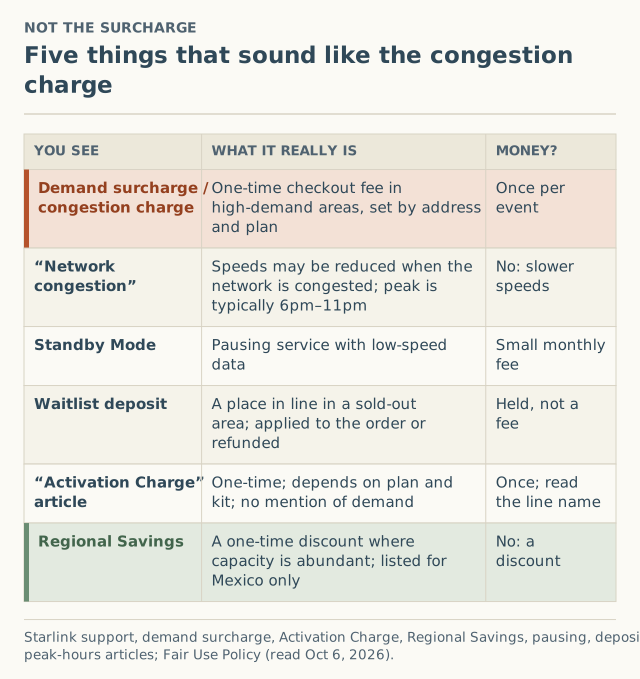
| You see or hear | What it really is | Costs money? |
|---|---|---|
| Demand surcharge / congestion charge | One-time checkout fee in high-demand areas, set by address and plan | Yes, once per triggering event |
| “Network congestion” slowing you down | Starlink “may temporarily reduce speeds if our network is congested” (Fair Use Policy); peak hours are “typically between 6pm and 11pm local time” | No. It shows up as slower speeds |
| Standby Mode fee | Pausing service “for a small monthly fee” with low-speed data | Yes, monthly while paused |
| Waitlist deposit | Paid for a place in line when an area is sold out; applied to your order when you confirm, or “fully refunded” if you don’t confirm within 7 days | Held, not a fee |
| “Activation Charge” article | A one-time charge that “depends on the service plan you choose and/or the Starlink kit you select” | Yes, once; see below |
| Regional Savings | A one-time discount in areas “where Starlink has abundant network availability”, currently listed for Mexico only | No, it lowers the price |
The Activation Charge article
This one deserves a closer look because its wording is close to the 2024 congestion text. Starlink’s article “What is an ‘Activation Charge’?” (created June 9, 2025, modified July 10, 2026) says: “There is an additional one-time charge to purchase Starlink services. The additional charge depends on the service plan you choose and/or the Starlink kit you select.” It adds that the charge “will only apply if you are purchasing or activating a new service plan,” may apply again on an address or plan change, and is refunded if you return the kit within 30 days.
What it doesn’t say is anything about demand, congestion or high-demand areas. Starlink doesn’t explain whether, or how, the two articles relate. We don’t merge them. If your checkout shows a line, write down its exact name and amount; that’s the only way to know which one you were charged.
Slow speeds are a separate problem
Many readers search “congestion charge” when their real question is why Starlink slows down in the evening. That’s network congestion as a performance issue, not a fee. Starlink’s plan terms say Residential 100 Mbps and 200 Mbps customers “are more likely to experience Service degradation and slower speeds during network congestion as compared to Residential Max customers.” For what local speed data can and can’t tell you, see why Starlink speed varies by location and our time-of-day speeds page.
Worked example: three headlines, one fee
Say you search before ordering and find three articles:
- A September 2024 post about a “$100 congestion charge” in Texas, Florida, Kansas, Ohio and Virginia.
- A June 2025 report of a “$750 surcharge” in Portland, Seattle and Spokane.
- A January 2026 report of a “$1,500 congestion charge” in Alaska.
Read correctly, these are one fee reported at three dates in different places, and none of them is your quote. The September 2024 article describes an early version of the rules, when the fee applied only to new service plans; Starlink’s current article lists more triggers. The only figure that applies to you is the one on your own checkout, at your real service address, for the plan you pick. How to get it without ordering: check for a surcharge before you order.
How we handle the two names
On this site, both names point to one fee:
- Our surcharge explorer and dated history file every report under “demand surcharge”, whatever the source called it.
- Press amounts stay in the press layer, labeled unverified, and never enter crowd medians.
- Our glossary lists “congestion charge” and “congestion fee” as other names for the demand surcharge.
- Site search treats “congestion charge”, “congestion fee” and “demand surcharge” as the same query.
When you report a quote, choose the event (new order, reactivation, address change, plan switch) and the amount. There’s no need to say which name your screen used.
Edge cases
- Your bill uses a different name. Note the wording and the date. If you think the charge is wrong, Starlink’s article says: “If you believe you were incorrectly charged the demand surcharge, please create a ticket for further review.”
- A retailer calls it something else. The surcharge is tied to the service address and plan at activation, not to where you bought the kit. See does buying at a store avoid it?
- You saw “sold out” instead of a fee. That’s a capacity block, not a charge; it’s covered on the sold-out log.
What we don’t know
- Exactly when the checkout label changed. We have press quotes using each name, not dated screenshots of the checkout line. Starlink doesn’t publish a change log for line-item names.
- Whether every checkout uses the same label today. We’ve seen both names in Starlink’s own text. If yours says something else, tell us the month and plan (never your address).
- How the Activation Charge relates. Starlink’s two articles don’t reference each other.
Common mistakes
- Treating two names as two fees. Searching only one name hides half the history.
- Treating slow evening speeds as a fee. Congestion as a performance problem costs nothing extra; it’s a speed question.
- Trusting an old amount. Reports range from $100 in 2024 to $1,500 in 2026, all press layer and unverified. Check the date of anything you read.
- Assuming a waitlist deposit is a surcharge. A deposit holds your place in line; it isn’t a charge for capacity.
What to do next
- Get your own figure: start an order at your real service address and stop before paying (how).
- See what triggers it and when it can come back: triggers and one-time or repeat.
- Compare with your county on the surcharge explorer, where cells publish at n ≥ 5 reports.
- Report what you saw. County only, no account.
Questions people ask
Is the Starlink congestion charge the same as the demand surcharge?
Why do news stories say congestion charge?
Is the congestion charge monthly?
Is the Starlink Activation Charge the same as the demand surcharge?
Does network congestion slow my Starlink down?
What should I search for when researching the fee?
Sources
- Starlink support: What is a demand surcharge? (created Sep 11, 2024; modified Apr 9, 2026) (retrieved Oct 6, 2026)
- Starlink support: What are regional savings? (modified Apr 9, 2026) (retrieved Oct 6, 2026)
- Starlink support: What is an 'Activation Charge'? (modified Jul 10, 2026) (retrieved Oct 6, 2026)
- Starlink support: Slow Speeds - Outside/During Peak Hours (modified Apr 9, 2026) (retrieved Oct 6, 2026)
- Starlink support: Deposit/Pre-Order - Status and how to confirm my order when it's my turn (modified Apr 9, 2026) (retrieved Oct 6, 2026)
- Starlink support: How does pausing service work? (modified Apr 9, 2026) (retrieved Oct 6, 2026)
- Starlink Fair Use Policy (retrieved Oct 6, 2026)
- Starlink Service Plan Descriptions (US legal document) (retrieved Oct 6, 2026)
- Blandin on Broadband (summarizing PCMag): Starlink charges $100 congestion charge, Sep 20, 2024 (retrieved Oct 6, 2026)
- APH Networks: SpaceX increases Starlink congestion charge in several US cities, Apr 22, 2025 (retrieved Oct 5, 2026)
- GSMGoTech: Starlink demand surcharge report, Jul 2, 2025 (retrieved Oct 5, 2026)
- SatelliteInternet.com: Starlink congestion charge up to $1,500, Jan 27, 2026 (retrieved Oct 5, 2026)
- MobileSyrup: $1,500 Starlink surcharge after address verification, Jul 2, 2026 (retrieved Oct 6, 2026)
Related guides
Surcharges
What triggers a Starlink demand surcharge? One flowchart
The four events that trigger a Starlink demand surcharge, the one condition behind all of them, and the edge cases: moves, Standby, plan switches.
Surcharges
How to check for a Starlink surcharge before you order
The only place a Starlink demand surcharge shows is checkout. How to get a real quote at your address, what to write down, and where to stop before paying.
Speeds
Why Starlink speed varies by location: causes ranked by evidence
Why Starlink is faster in one place than another: peak demand, local capacity, plan caps, obstructions, Wi-Fi and location, each with how well it's documented.